The biggest land mine people face when defining KPIs is starting with web analytics tools. The brightly coloured reports with the ability to measure 101 different metrics can make you feel like a kid in a candy store. However, KPIs are not about what you can measure...they are about measuring business outcomes and creating actionable insights. To be effective, KPIs must be derived from strategy.
The measurement journey
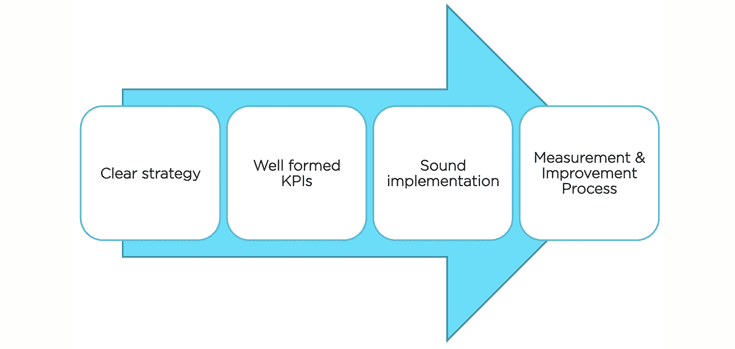
Start with strategy
Key Performance Indicators are just that... key! They are the main measures of your strategy. They should tell you if your strategy is successful, and if not, give you a clear idea of what needs to be improved. They do not measure individual campaigns or tactics (although you probably have metrics for these, they are not your KPIs).
While there are many blog posts and books that go much deeper into the subject, the two basic components of any digital strategy are:
- Why? (The Vision Statement)
- How? (The Strategic Plan)
Many times companies have implicit plans or unclear strategy. Take the time to work with your stakeholders and make sure it's clearly defined. You can't have clear measurements without a clear strategy.
Forming your KPIs
Let's start by defining the term key performance indicator.
“(KPIs) are simply a tool for assessing the impact of a particular project or activity. While these are often numeric in nature (‘improve sales by 20%’) they can also be qualitative (‘improve staff satisfaction levels’). In either case, metrics provide clear and tangible goals for a project, and criteria for project success.” — James Robertson, Metrics for knowledge management and content management.
Working in a group with stakeholders, and using your strategy as a guide, start by asking "What might we observe if success (the desired results) were happening?".
There are five different types of success evidence for digital projects: financial, behavioural, technical, attitudinal, and experiential. Let's look at some examples.
| Desired Result | Success Evidence Type | Success Evidence Example |
| User Generated Reviews Increase Widget Sales | Financial | Average Order Value for visits with user reviews are higher than those without |
| User Generated Reviews Increase Widget Sales | Behavioural | Users that read reviews are more likely to purchase than those that do notMore widgets are added to the cart in visits that include user reviews |
| Lower Content Costs | Financial | Total content costs decreaseContent cost per asset decreases |
| Social media followers refer new clients | Behavioural | Followers use our “Buy from Acme like me!” widget(Positive) follower mentions refer new visitors |
| Social media followers think of us when it is time for a new widget | Behavioural | Twitter followers become widget sales leads |
| Pages load more quickly | Technical | Average page load time |
| Customers express satisfaction with the self-serve portal | Attitudinal | Average customer satisfaction with self-serve portal |
Turning evidence examples into metrics
Once you have defined success, take your evidence and think of ways you can measure it. Make a laundry list of all metrics you can think of. We can prune this down later. Here are a few examples, based on success evidence we defined above:
| Success Evidence | Metric |
| Average Order Value for visits with user reviews are higher than those without | - User Review Visit Average Order Value
- Non-user Review Visit Average Order Value
|
| Users that read reviews are more likely to purchase than those that do not | - Review-Reader purchase rate (# of Visits where reviews are read that include a purchase / Total Visits where reviews are read)
- Non-Review-Reader purchase rate
|
| More widgets are added to the cart in visits that include user reviews | - Average number of widgets added to cart / Review Visit
- Average number of widgets added to cart / Non-Review Visit
|
| Total content costs decrease | |
Refine your list for relevance (does it really measure the business outcome?), feasibility (do I have the tools to measure it on a regular basis?) and action-ability (can we use it to make better decisions?).
Six pro-tips for KPI development
- Work in a group: Collaboration ensures buy-in. That way, when reviewing results monthly or quarterly, the focus will be on "What should we do about the results?" rather than "Are these the right measurements?"
- Favour rates, ratios, and percentages, and averages: These types of measurements allow you to make comparisons over time easily and adjust for differences in units.
- Only the precious few measures get to be KPI’s: What metrics are absolutely mission-critical? Which ones would you take to a deserted island? Cut it down to a short list of the most important metrics.
- Avoid rehashing measurements every review: Strategy shouldn't change every month or every quarter. Neither should metrics. Provided KPIs are chosen carefully, they can be measured over a longer period of time to observe trends. Refine measurements only when strategy is changing.
- Implement and test before launch: Many times, particularly with web analytics, specific tracking codes will need to be added in order to measure the desired outcomes. Failing to implement these correctly will cause data to be lost. We recommend using tools like Google Tag Manager to test your implementation.
- Every KPI needs an owner: Who's accountable for the metric? Who is responsible for reporting on the metric? How frequently will the results be measured. Define roles and responsibilities up front.
Ongoing measurement and continuous improvement
The first thing you want to measure is your baseline data. A baseline is the initial known value which is used for comparison with later data. The best approach is to take data from the same time period in previous years. If this is unavailable, take the longest period that you can get (ie. the previous quarter is better than the previous month). Use your baselines to create targets for your KPIs.
The final step is to summarize all your lovely KPIs and targets into a beautiful dashboard, so you can quickly analyze them and agree on action plans. The best dashboards are really simple. Display your KPIs and targets in a way where readers can easily see if targets are being met over time. Include notes on key insights, actions and steps being taken, and KPI definitions. Avanish Kaushik’s post on Strategic & Tactical Dashboard Design provides some excellent examples.