





From January 20–22, 2026, OXD team members along with BC Parks’ product owner, participated in a hackathon organized by the British Columbia (BC) Government’s Digital Delivery Services team. The team’s challenge focused on improving how staff across ministries could create and share branded, critical, and time-sensitive content both internally and externally to citizens.
The problem: Balancing speed and quality in government communications
Staff across government face a significant challenge: with competing priorities and limited experience in digital content creation, many struggle to produce citizen-friendly content that meets BC Government writing guidelines. This often means web teams must provide extensive feedback, ask clarifying questions, or completely rewrite submissions—creating delays in getting crucial, time-sensitive information to both internal staff and the public.
Inspired by working with BC Parks and advisories to keep park visitors aware of conditions that may affect their safety and experience, our team wanted to create a solution where advisories and communications could be posted quickly while following specific writing guidelines to ensure clarity and usefulness for diverse audiences.
Our mission: Bridge the gap with AI
Embracing the hackathon’s fun ‘90s theme, our “8-Bit Editors” team—comprising a product owner, three developers, a QA engineer, a UX designer, a visual designer, and a project manager—identified an opportunity to use AI to bridge this gap. We needed a solution that could help staff across ministries write better communications from the start, reducing revision cycles and getting important information delivered faster.

Our goal was to create an intelligent writing assistant that could guide staff through the communications creation process while maintaining writing quality standards and voice.
Example use cases:
- A regional BC Parks staff member reporting a bear sighting could receive real-time suggestions to improve clarity for essential safety alerts.
- Staff across government who needed to post alerts or write service/program descriptions and reports in a specific writing style including tone, grammar, and active voice.
- Staff with varying writing experience could produce consistent, high-quality content that serves diverse citizens’ needs.
Our approach: Assembling the right team and tech stack
The 8-Bit Editors team brought together expertise across product management, development, design, and quality assurance to tackle this challenge. We focused on understanding the specific pain points in the current workflow and designing a solution that would feel natural to use while dramatically improving output quality.
Our technology stack included:
- FastAPI for the backend API
- OpenAI API for natural language processing and content enhancement
- Pydantic for data validation and ensuring content quality
- Nuxt 4 (Vue.js) for a responsive, user-friendly frontend
- Bootstrap 5 for consistent, accessible UI components
Our solution: A writing assistant that works in real-time
In three days, we developed a staff writing assistant prototype that demonstrates how AI can empower government staff to create better, on-brand communications with less friction. The tool provides intelligent, context-aware guidance throughout the writing process.
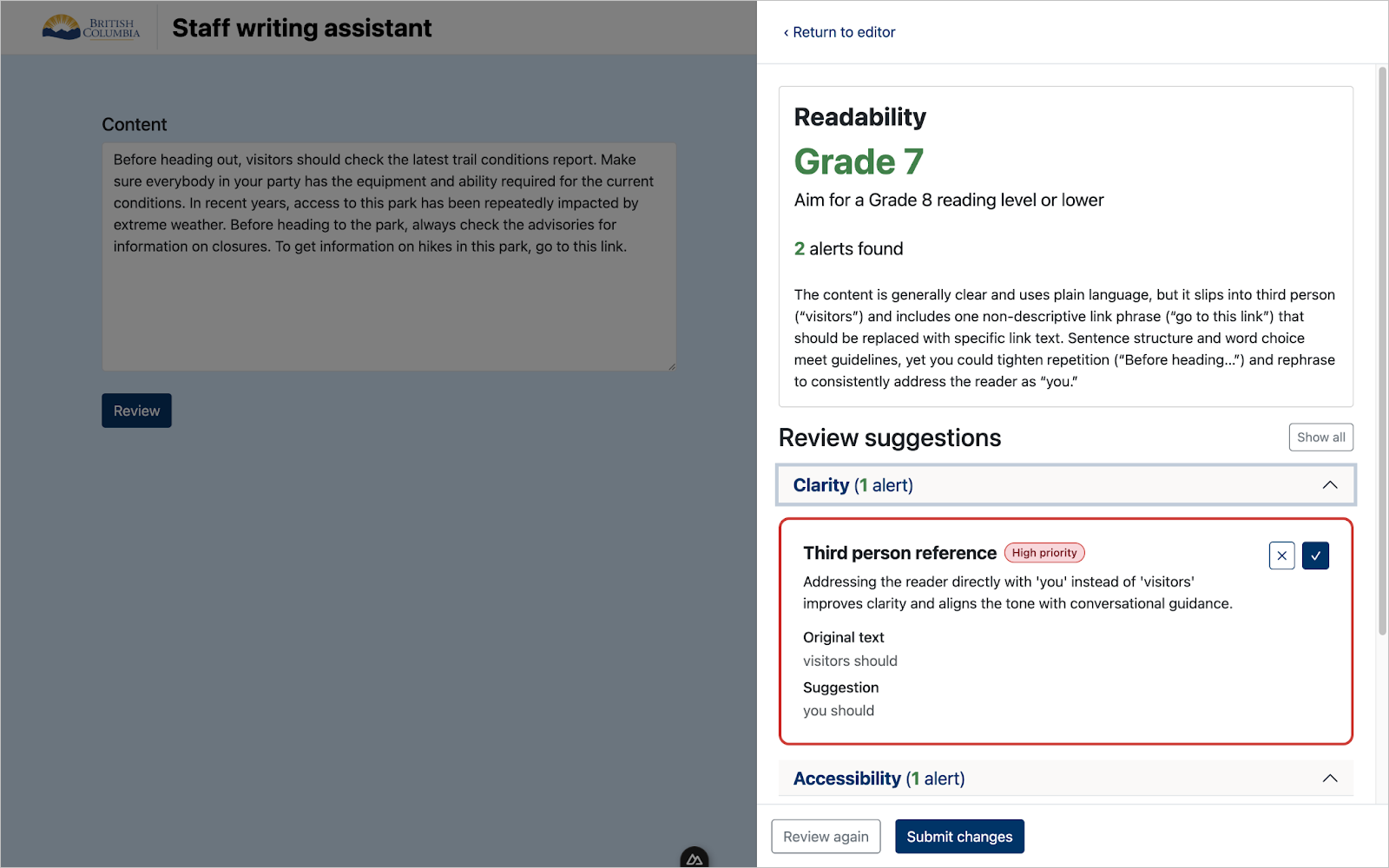
Key features included:
- Real-time writing assistance that suggests improvements while staff compose content
- AI-powered content enhancement that can maintain BC government voice and standards
- Validation to ensure all critical information is included
- User-friendly interface designed specifically for staff workflows
- Integration potential with existing government systems
The writing assistant helps staff produce clear, complete, and people-focused communications on their first attempt, reducing the need for extensive revisions and enabling faster publication of time-sensitive information.
The potential to transform government communications
Within the hackathon timeframe, our prototype showcased the possibility for AI to transform how the BC Government communicates internally and with citizens. The writing assistant enables staff to produce high-quality content efficiently, ensuring time-sensitive information can reach people without unnecessary delays.
By reducing the revision burden on web teams and empowering staff with real-time guidance, this tool has the potential to improve both the speed and quality of communications across ministries. Most importantly, it could help ensure citizens have the information they need to make informed, timely decisions.